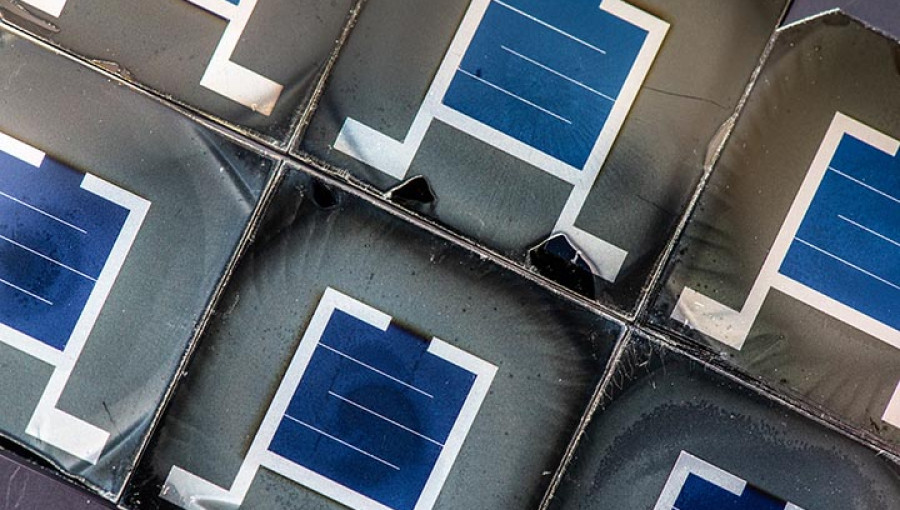
Researchers Develop Method To Boost Solar Cell Efficiency By Controlling Light Emission
By narrowing the angular range of emitted photons, scientists aim to surpass the theoretical efficiency limits of single-junction solar cells.

Researchers at the Institute of Photonic Sciences (ICFO) in Barcelona have demonstrated a new technique to reduce energy loss in solar cells by restricting the directions in which they emit light. By narrowing the angular range of photon emission to better match the narrow cone of incoming sunlight, the team aims to overcome the conventional theoretical efficiency ceiling for single-junction devices.
The study, published in Energy & Environmental Science, addresses a phenomenon known as Boltzmann loss. Because materials that absorb light can also emit it, the mismatch between the narrow angle of incoming sunlight and the broad range of emitted photons results in lost potential energy. The researchers addressed this by transforming an inverted organic solar cell into an optical cavity.
Led by Professor Jordi Martorell, the team utilized a silver-based front electrode combined with a layered structure and a rear electrode to create the cavity. This design suppresses light emission at wide angles while maintaining efficient light absorption. The researchers noted that this approach does not add significant fabrication complexity compared to other methods intended to improve photovoltaic performance.
While the standard Shockley–Queisser limit for single-junction solar cells is 33.16 percent, the researchers suggest that sufficiently narrowing the emission cone could theoretically allow efficiencies to approach 43 percent. Although the experiment used an organic solar cell based on the PM6:Y6 material blend, the team stated that the underlying principle could potentially be applied to other photovoltaic technologies.
Dr. Francisco Bernal Texca, the study's first author, described the work as a significant step toward surpassing the Shockley–Queisser limit. If successfully scaled, the researchers believe this method of controlling photon emission could increase electricity generation from the same amount of sunlight, potentially reducing the land and material requirements for solar installations.