Korean Researchers Set New Efficiency Record For Tandem Solar Cells

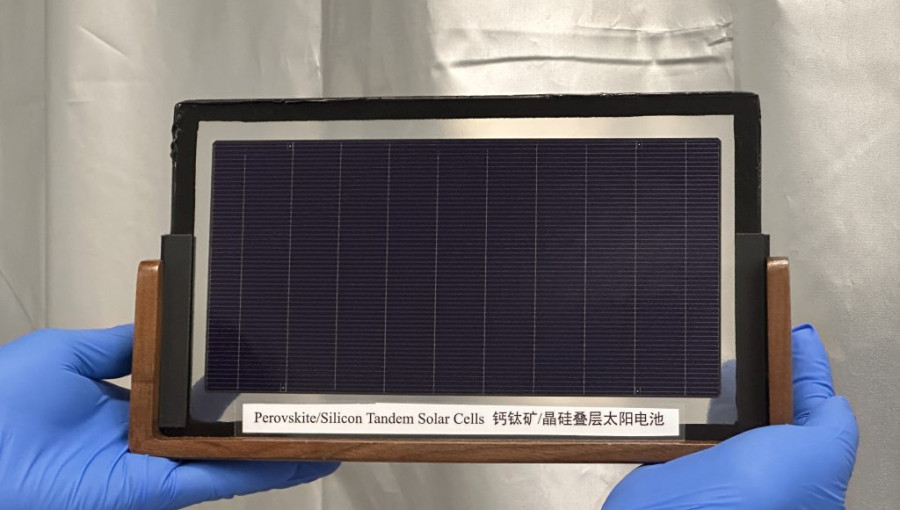
Researchers at the Korea Institute of Energy Research (KIER) have established a new world record for thin-film tandem solar cell efficiency, reaching an officially certified 26.7 percent. By stacking a perovskite layer atop a copper indium gallium selenide (CIGS) layer, the team created a lightweight, flexible device capable of capturing a broader range of the solar spectrum. This breakthrough, verified by Germany’s Fraunhofer Institute for Solar Energy Systems, surpasses previous records and highlights the potential for these high-efficiency cells to power future space-based infrastructure, such as satellites and data centers, where weight and performance are critical.
The tandem design functions by utilizing the complementary bandgaps of the two materials. The top perovskite layer captures high-energy ultraviolet and blue light, while the bottom CIGS layer absorbs the remaining near-infrared wavelengths. To achieve this record, the KIER team developed advanced interfacial protection layers and re-engineered the transparent top electrode. These innovations minimize electrical damage and optical losses that typically occur when combining delicate thin films, allowing the researchers to reach laboratory-measured efficiencies as high as 27 percent.
This achievement underscores South Korea’s growing influence in next-generation photovoltaic technology, eclipsing the previous 26.3 percent record set by a joint team from Seoul National University and KIST. While the current 26.7 percent benchmark applies to small-area laboratory cells, the technology offers significant promise for broader applications. Due to their thin-film nature, these modules are well-suited for integration into vehicles, buildings, and space environments. KIER is currently collaborating with industry partners to transition this technology from small-scale laboratory samples into larger, commercially viable solar modules.