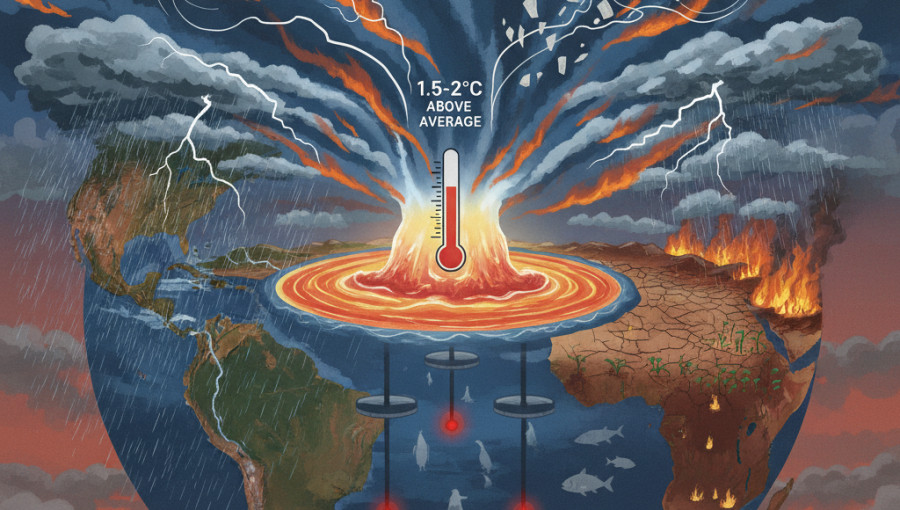
Super El Niño Threatens Global Health With Extreme Warming

A new study from the University of Chicago Climate Impact Lab warns that a super El Niño event could cause over 451,000 heat-related deaths globally within the next six months. By releasing significant ocean heat into the atmosphere, this climate phenomenon is expected to drive land temperatures to levels not typically anticipated for another two decades. Researchers emphasize that these projections represent a critical window for humanitarian organizations and governments to implement emergency interventions, such as cooling centers and health outreach, to mitigate the impact of this accelerated warming on vulnerable populations worldwide.
The El Niño cycle, which began in June, is intensifying global land temperatures and shifting rainfall patterns, creating conditions that mirror the long-term effects of climate change. Scientists note that this event effectively leapfrogs the planet into a future climate state before societies have had sufficient time to adapt. The projected death toll is expected to be particularly severe in Nigeria, Indonesia, Sudan, India, and Brazil, which together account for more than 97,000 of the estimated fatalities. The United States is also among the top 20 most affected nations, with an estimated 3,500 additional heat-related deaths.
Humanitarian groups, including the International Federation of Red Cross and Red Crescent Societies, are already mobilizing to address these risks by strengthening early warning systems and supporting climate-resilient agricultural practices. Experts stress that while emergency responses can save lives in the immediate term, the long-term challenge remains the need for structural adaptation. As this El Niño threatens to push global temperatures past the 1.5 degrees Celsius threshold, researchers warn that the world must transition away from a constant state of emergency to avoid the catastrophic consequences of a permanently warmer climate.