South Korea Launches US$747 Billion Green Industrial Strategy
The initiative targets 100GW of renewable energy by 2030 through domestic production incentives and significant power grid reforms.
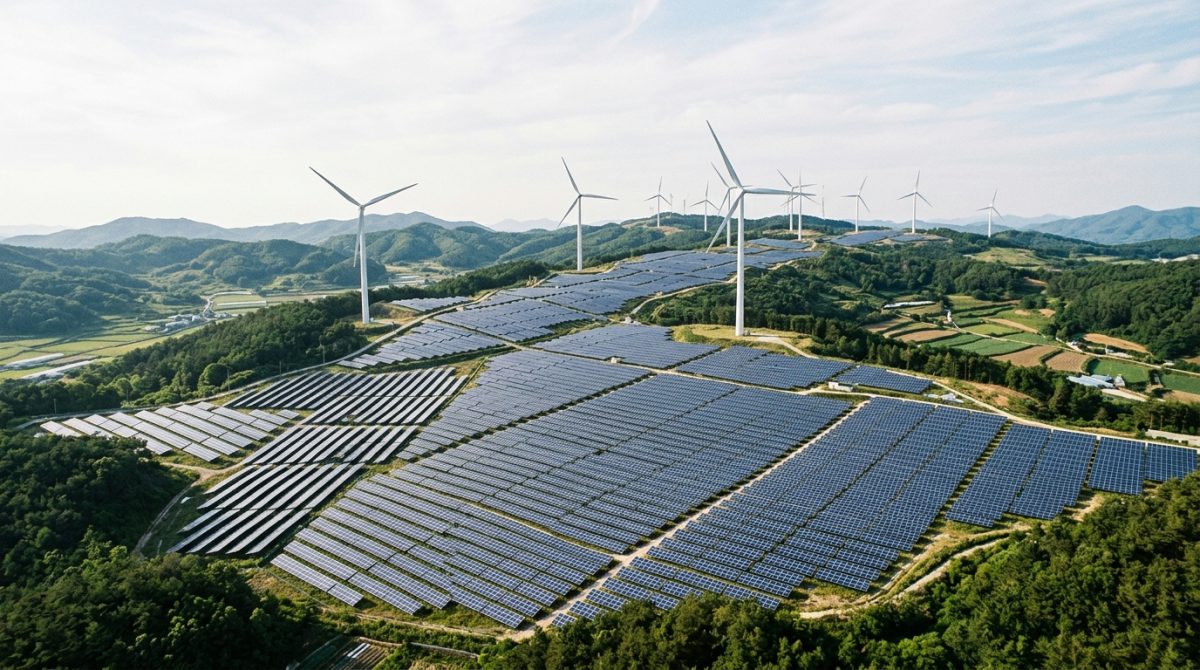
The South Korean Ministry of Climate, Energy and Environment has introduced the Korean Green Transformation industrial strategy, a KRW1,000 trillion, or US$747 billion, plan designed to boost low-carbon technology manufacturing. The strategy aims to support the national goal of reaching 100GW of renewable energy capacity by 2030 while strengthening domestic supply chains for solar, battery, and electric vehicle industries.
The government will invest KRW200 trillion in fiscal funds and KRW790 trillion in climate finance over the next decade, supplemented by KRW220 trillion in private-sector investment. To encourage growth, the plan includes tax credits for solar PV, wind, and battery storage production, alongside regulatory improvements and fast-track licensing for core technology companies.
A central component of the strategy is the Power Grid Innovation Plan, which seeks to address grid constraints that currently limit renewable energy expansion. The government intends to implement flexible grid connections, prioritizing new generators based on available capacity rather than rated capacity. Additionally, the plan introduces non-wires alternatives, using battery energy storage systems to mitigate congestion at substations and on distribution networks.
Reforms to grid connection rights will shift from a first-come, first-served model to a competitive bidding process starting in January 2027. Furthermore, the state-owned utility KEPCO will take responsibility for initial infrastructure upgrade investments, with costs shared among subsequent developers. These grid measures are expected to allow for significant additional renewable energy capacity, including 20GW through priority dispatch over fossil fuels.
The Ministry also recently launched a Central Contract Market procurement for 1,180MW of energy storage, targeting deployment on the mainland and Jeju Island by February 2029. These efforts align with the 2025 Basic Plan on Electricity Supply and Demand, which projects a total generation capacity of 157.8GW by 2038, with a goal of 70.7% carbon-free electricity.