India Considers Financial Incentives To Support Five Gigawatts Of Agrivoltaics
The Ministry of New and Renewable Energy aims to boost dual-use land projects by addressing the higher costs associated with elevated solar panel structures.
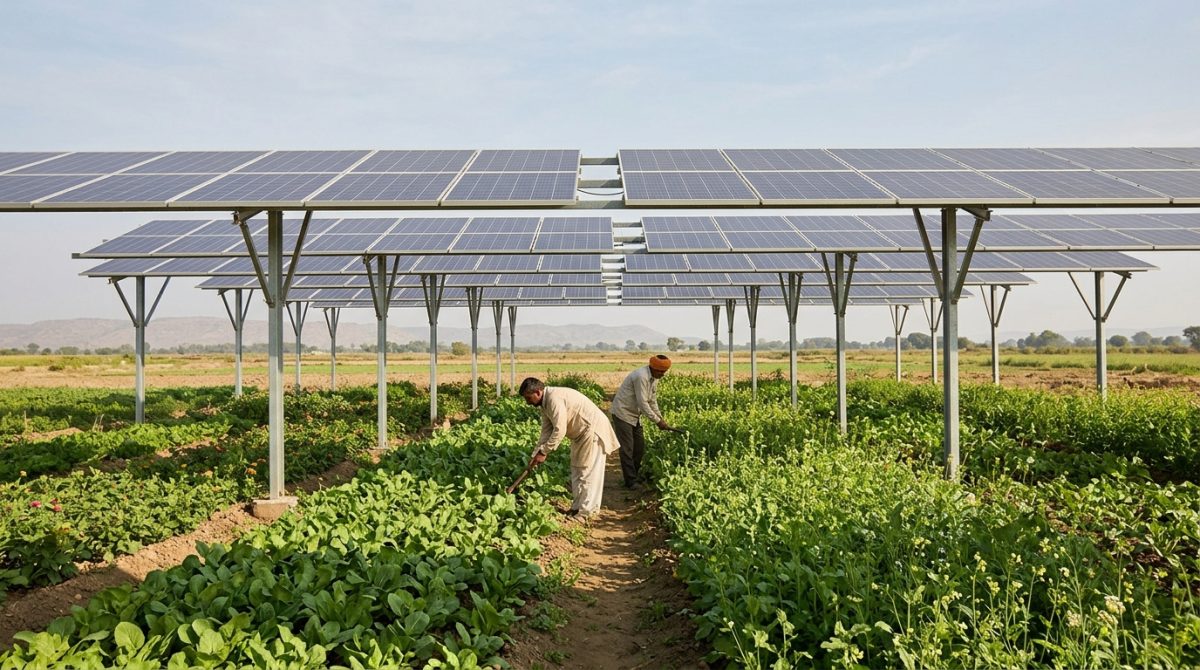
The Indian government is evaluating a new financial support scheme to promote agrivoltaics, a practice that combines solar power generation with agricultural activities on the same land. The Ministry of New and Renewable Energy (MNRE) estimates that the country could deploy approximately 5 GW of agrivoltaic capacity over the next three to four years through this initiative.
MNRE Secretary Santosh Kumar Sarangi stated that the government is currently working with the Ministry of Finance to determine whether this support should be integrated into the existing Pradhan Mantri Kisan Urja Suraksha evam Utthaan Mahabhiyan (PM-KUSUM) scheme or launched as a standalone program. The ministry is also drafting a policy document to guide development and is engaging with electricity distribution companies to ensure power purchase agreements are facilitated.
Agrivoltaic projects involve mounting solar panels on elevated structures to allow for farming underneath. According to Sarangi, these installations typically cost 25% to 30% more than conventional ground-mounted solar projects due to the specialized infrastructure required. The ministry estimates that electricity generated from these plants could cost between INR 3.20 and INR 3.30 per kWh, compared to the INR 2.80 to INR 3 per kWh range for decentralized solar projects under PM-KUSUM.
The success of the 5 GW target will depend partly on state governments implementing appropriate feed-in tariffs. The ministry has conducted trials with the Indian Agricultural Research Institute (IARI) to determine which crops are most suitable for these systems. While results for fruits and leafy vegetables have been positive, the approach has proven less effective for rice and sugarcane. The government has identified Madhya Pradesh, Odisha, Chhattisgarh, West Bengal, and Uttar Pradesh as key states for potential deployment.
By promoting agrivoltaics, the government aims to expand solar power deployment beyond the five states that currently account for 85% of the country's solar capacity. This strategy is intended to reduce land-use competition and allow for solar growth in regions with limited non-agricultural land. India’s total technical potential for agrivoltaics is estimated to be between 1 TW and 2 TW.