
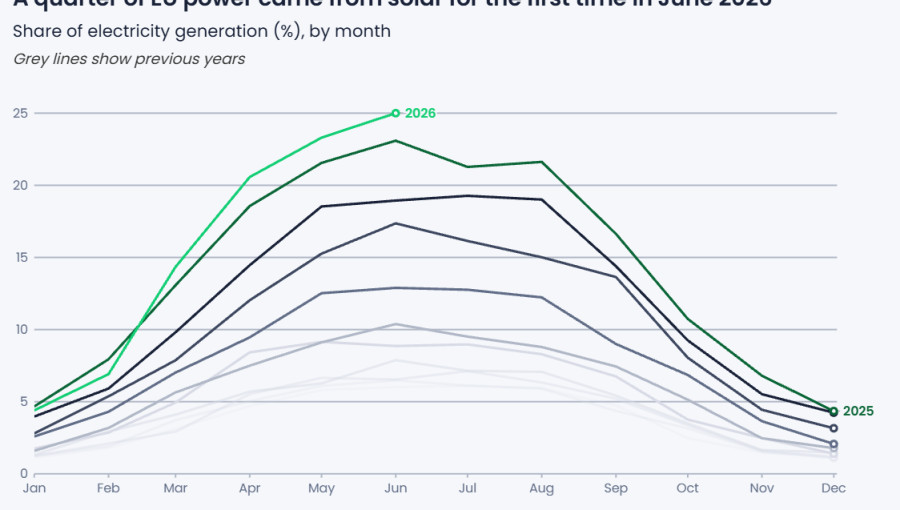
For the first time in history, solar PV accounted for 25% of the European Union’s total electricity generation during June 2026. Data from the think tank Ember confirms that solar modules produced a record 52TWh of power, surpassing nuclear energy’s 21% share to become the continent’s primary electricity source. This milestone follows a period of rapid expansion, with solar output more than doubling from the 21TWh recorded in June 2021. The surge in production proved vital in meeting elevated cooling demands triggered by intense heatwaves, underscoring the technology’s increasingly critical role in the European energy landscape.
The rapid ascent of solar power has consistently outperformed industry forecasts, transitioning from a minor contributor to a cornerstone of the regional power grid. According to Ember senior energy analyst Chris Rosslowe, the shift reflects a widespread preference among citizens and governments for affordable, rapidly deployable domestic energy solutions. This trend is evident across the bloc, as 18 of the 27 EU member states established new monthly records for solar energy penetration throughout 2026, highlighting the widespread adoption of the technology across diverse national markets.
Individual nations have reported significant breakthroughs in their respective energy transitions. Spain achieved a major milestone in June, with solar PV contributing over 34% of its total electricity generation. This shift has helped mitigate the impact of volatile gas prices on consumer utility bills. Meanwhile, Germany, which maintains the largest installed solar capacity in Europe, reached a new high of 36% solar generation in June. Even Poland, traditionally reliant on coal, saw solar energy account for 24% of its power mix, marking a period of rapid capacity growth that added over 20GW of solar infrastructure since 2020.