
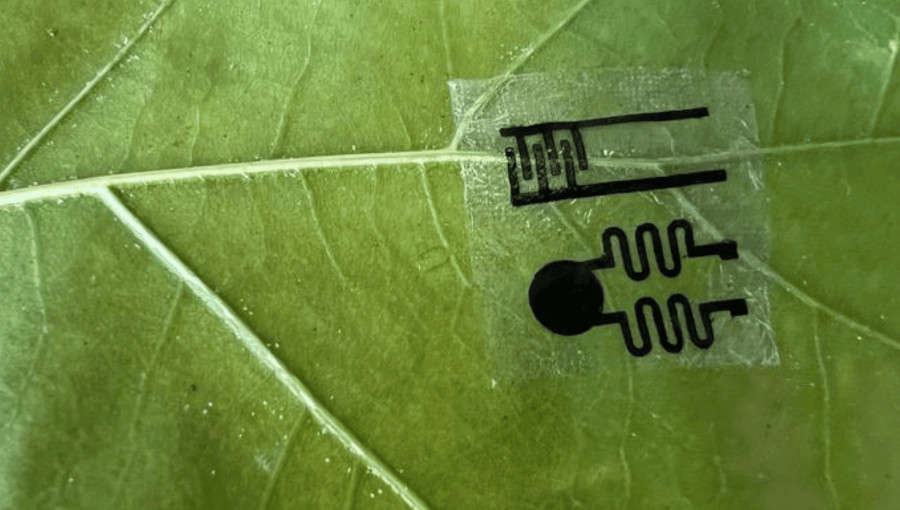
Researchers at Tufts University have developed innovative wearable sensors for plants, offering farmers a way to monitor crop health in real time. Unlike traditional methods like drones or soil sensors, which often detect issues only after visible damage has occurred, these new devices provide an early warning system. By attaching directly to leaves and stems, the sensors track humidity, temperature, and growth patterns. This technology, which operates without external batteries by utilizing the plant’s own moisture for power, could eventually allow for large-scale networks that provide detailed insights into nutrient levels and stress factors.
The system consists of two distinct components: a leaf-based sensor and a stem band. The leaf sensor, constructed from carbon and thin crystal sheets, generates a small electrical current as water evaporates from the plant, effectively powering itself. This allows for continuous data collection without the logistical challenges of replacing batteries in a field setting. Meanwhile, the stem band utilizes a kirigami-inspired design, allowing it to expand and contract with the plant’s growth. This mechanism helps farmers distinguish between healthy development and physical stress caused by dehydration or environmental conditions.
During testing on bell pepper plants, the sensors successfully identified various states of health, including reactions to salt stress and water scarcity. The devices proved durable enough to withstand outdoor conditions, such as wind and physical movement. Looking ahead, the research team aims to expand the sensors’ capabilities to track plant hormones and specific nutrient levels. By creating a network of these monitors, farmers could transition from relying solely on broad aerial surveys to receiving intimate, plant-level data, potentially revolutionizing how agricultural stress and disease are managed on a commercial scale.