
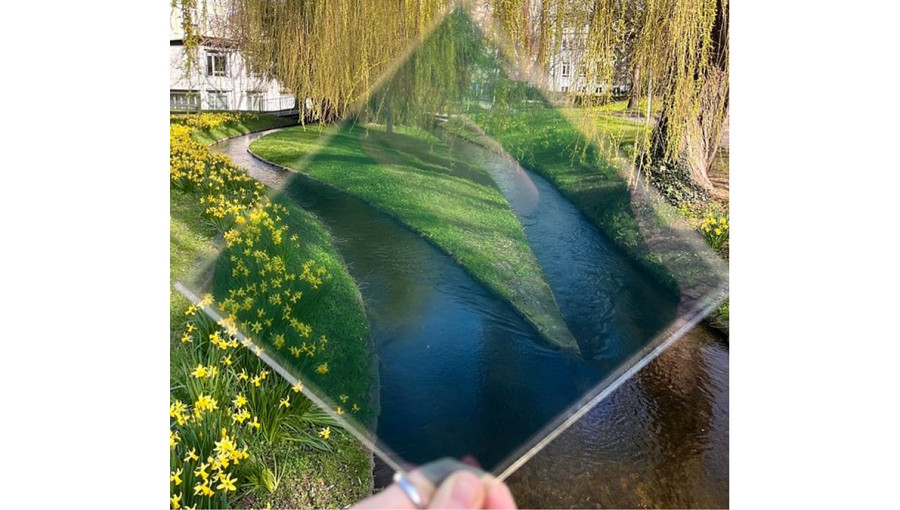
Researchers from the Fraunhofer Institute for Solar Energy Systems (Fraunhofer ISE) and the University of Freiburg have successfully developed semi-transparent organic photovoltaic modules using scalable industrial manufacturing techniques. These modules, which measure 210.25 cm², demonstrate an efficiency of 9.26% alongside a 43.2% visible-light transmittance. By utilizing slot-die coating and sputtering, the team has bridged the gap between laboratory-scale production and industrial feasibility. These flexible, semi-transparent solar modules are designed for integration into building façades, greenhouses, and vehicle roofs, offering a promising path toward versatile, light-transmitting power generation that maintains high performance even after repeated mechanical stress.
The development process focused on overcoming the traditional difficulties of scaling organic PV technology. By employing slot-die coating for the solar cell layers and sputtering for the back electrode, the researchers ensured the process remains compatible with large-scale production. Each module features over 100 interconnected solar cells created through laser structuring. The architecture includes a specialized back electrode that redirects near-infrared light into the absorber layer, paired with a metal-free top electrode composed of the conductive polymer PEDOT:PSS, which was formulated by Heraeus Epurio to enhance transparency.
These modules achieve a light utilization efficiency of up to 4.0%, a key metric balancing power conversion with light transmission. The research team suggests that further refinements could push light transmittance beyond 50%, potentially allowing these modules to serve as direct replacements for standard window glass in architectural and agricultural settings. For applications where tinted surfaces are desirable, such as vehicle roofs, lower-transparency versions remain a viable option.
Because the slot-die coating method is compatible with roll-to-roll manufacturing, the technology is well-suited for production on flexible films. Testing confirmed the durability of these prototypes, which maintained their full initial efficiency after undergoing 1,274 bending cycles. Moving forward, the project team, which includes film manufacturer ROWO Coating, intends to focus on scaling up the surface area of these flexible modules. The findings of this research have been detailed in the journal Joule.