
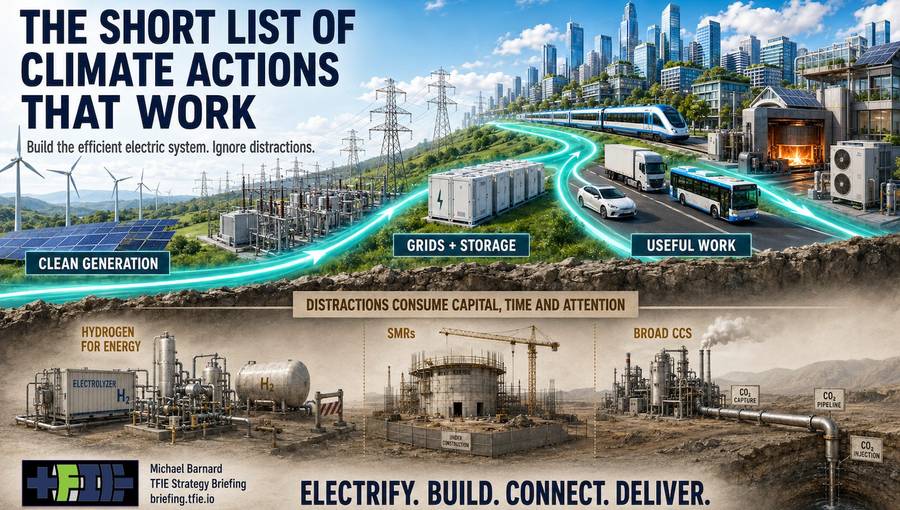
Effective climate strategy does not require an endless list of speculative technologies; instead, it demands a focus on proven, scalable solutions that align with physics and economic reality. The path forward centers on electrifying the economy, overbuilding renewable energy capacity, and expanding continent-scale grids. By prioritizing direct electrification over inefficient synthetic fuels and utilizing batteries and pumped hydro for storage, institutions can achieve deep decarbonization. Success depends on moving past distractions, implementing carbon pricing, and strategically retiring fossil fuel assets, ensuring that policy and capital are directed toward the most efficient pathways for reducing global emissions.
The primary objective of an energy transition is to provide useful work—such as heat, mobility, and industrial production—rather than simply fueling combustion. Electrification is the most efficient way to achieve this, as electric vehicles and heat pumps drastically reduce the energy waste inherent in burning fuels. While synthetic fuels and hydrogen have niche roles in specific industrial or maritime applications, they are generally poor substitutes for direct electricity. Consequently, the grid must be designed for resilience by overbuilding wind and solar capacity by roughly 25%, treating this surplus as a necessary reserve rather than waste.
To support this electrified future, continent-scale grids are essential. High-voltage direct-current (HVDC) transmission acts as the new backbone of the energy system, allowing regions to share renewable surpluses and balance demand across borders. This bulk infrastructure must be complemented by localized storage and flexible demand management. Batteries, now increasingly cost-effective, are leading the storage transition, while pumped hydro remains a vital anchor for long-duration needs. By avoiding the temptation to rely on unproven or slow-to-deploy technologies, governments and utilities can focus on the infrastructure—factories, grids, and permitting—that can realistically displace emissions at the required speed and scale.