
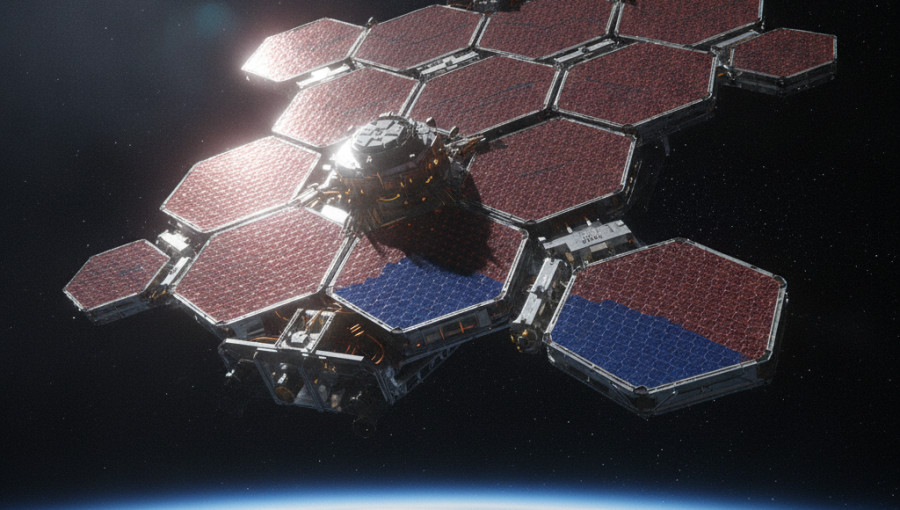
A collaborative team of researchers from several Chinese institutions has developed a perovskite/silicon tandem solar cell specifically engineered for space environments. The device achieved a record-breaking 27.49% power conversion efficiency under AM0 illumination, the standard for space-based solar power. By utilizing a p-type silicon bottom cell and optimizing the perovskite top cell’s bandgap to 1.72 eV, the team successfully mitigated the performance degradation typically caused by high-energy electron and proton radiation. The tandem demonstrated remarkable resilience during extreme thermal cycling and a successful high-altitude balloon flight, proving its viability for future orbital missions.
The development of this tandem cell addresses the unique challenges of low Earth orbit, where solar modules must endure constant bombardment by high-energy particles and rapid temperature swings between -90°C and 90°C. While most terrestrial tandem research focuses on standard AM1.5G conditions, this project prioritized radiation tolerance. The researchers identified that n-type silicon cells suffer significant efficiency losses under radiation, whereas p-type silicon remains more robust. By integrating a 100-μm-thick p-type silicon bottom cell, the team created a more durable foundation for the device.
To further ensure longevity, the researchers adjusted the perovskite top cell’s bandgap to 1.72 eV. This modification allows more near-infrared light to reach the silicon layer, ensuring the two subcells remain current-matched even as the silicon degrades over time. To stabilize the perovskite material itself, the team incorporated an ionic liquid additive, 1,3-bis(cyanomethyl)imidazolium chloride, which improves crystal grain uniformity and reduces trap density. These enhancements resulted in a device that retained nearly 80% of its initial efficiency after significant electron irradiation, far outperforming standard 1.68 eV tandem configurations.
The practical performance of the technology was validated through rigorous stress testing. The tandem maintained 96.8% of its initial efficiency after thermal shock cycles and retained 93% of its output following proton irradiation. These lab results were confirmed during a high-altitude balloon flight, where the solar module reached an altitude of nearly 30 kilometers. Throughout the flight, the device provided stable power output under intense solar irradiance and low-pressure conditions, demonstrating that the design is capable of surviving the harsh realities of near-space operation without suffering encapsulation failure or performance decay.