
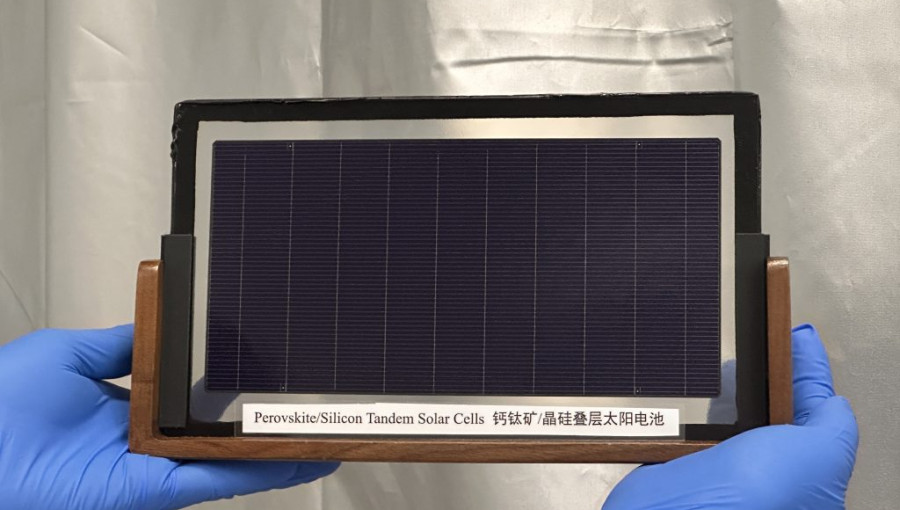
An international research team has achieved a significant breakthrough in photovoltaic technology by developing a high-performance, commercial-scale tandem solar cell that eliminates the need for indium. By substituting this scarce, expensive metal with abundant tin oxide, the researchers have created a more sustainable and cost-effective path for solar manufacturing. This innovation, which maintains high efficiency levels, addresses a critical bottleneck in the clean energy industry. The study, published in the journal Science, demonstrates that next-generation tandem solar cells can be scaled for mass production, potentially accelerating the global transition toward ultra-high-efficiency renewable energy systems.
The reliance on rare materials like indium has long hindered the large-scale deployment of advanced solar technologies. Because indium is primarily a byproduct of base-metal mining, its limited supply and high cost create significant barriers for manufacturers. To overcome these challenges, a collaborative group of researchers from China, Australia, and the UK utilized a low-damage reactive plasma deposition process to integrate tin oxide into the cells. This material costs only one percent as much as indium, providing a viable economic route for the industrialization of next-generation photovoltaics.
Beyond cost savings, the research team proved that performance does not need to be sacrificed for sustainability. The team successfully fabricated a 207.9 cm2 mini-module that achieved a certified efficiency of 31 percent. Furthermore, these indium-free cells demonstrated robust durability, maintaining strong performance after being subjected to heat, humidity, and over three months of continuous outdoor operation. Professor Yuan Cheng noted that reaching over 30 percent efficiency in a commercial-sized module is a major technical milestone, confirming that high-performance solar energy can be achieved without depending on rare, ethically complex, and expensive raw materials.