
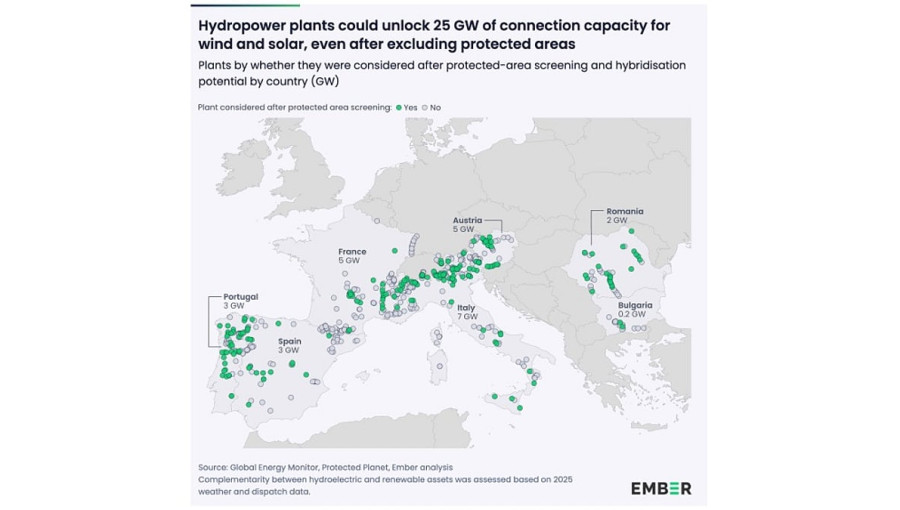
A new report from the energy think tank Ember reveals that existing hydropower plants across seven European Union nations could host up to 25 GW of additional wind and solar PV capacity. By integrating these renewable sources into current grid connections, the bloc could significantly boost its clean energy output without the need for costly or time-consuming infrastructure upgrades. This strategy, known as hybridization, offers a vital solution to the projected 120 GW grid capacity shortfall expected by 2030, allowing for faster deployment of renewables while maximizing the utility of existing power assets across the continent.
The analysis focuses on Austria, Bulgaria, France, Italy, Portugal, Romania, and Spain, which collectively account for 93 GW of the EU’s total hydropower capacity. Ember suggests that by installing wind and solar assets behind the meter at these sites, operators can utilize grid connections that are currently underused. For instance, reservoir and pumped-storage plants typically use only 19% of their grid capacity, a figure that could rise significantly through hybridization. Because solar generation often peaks during the day, it complements the morning and evening dispatch patterns of many hydropower facilities, creating a more balanced energy flow.
Despite the potential, the report highlights significant regulatory hurdles. Currently, only Portugal and Spain have established specific policies to support hybrid renewable projects. In other nations, a lack of dedicated regulations and slow permitting processes could hinder progress. Furthermore, while the 25 GW goal is technically feasible, grid constraints in countries like Portugal and Romania may complicate implementation within the next five years. Ember emphasizes that if these nations adopt faster permitting and clearer rules, they can unlock substantial renewable capacity, ensuring greater energy security and competitiveness while bypassing the immediate need for extensive network expansions.