
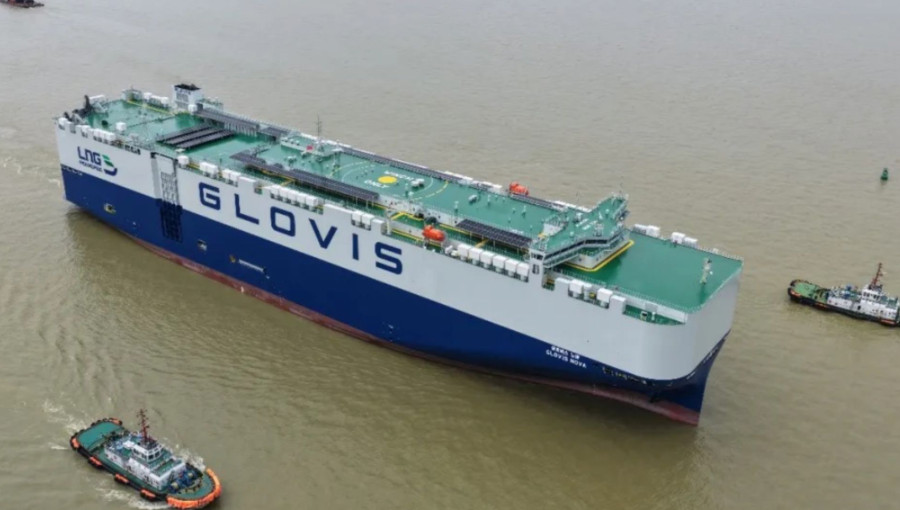
China has officially delivered the world’s first 10,000-vehicle-class car carrier integrated with a photovoltaic power generation system. Built by Guangzhou Shipyard International for the Korea Ocean Business Corporation, the 755-foot vessel is designed to transport up to 10,800 vehicles. By combining solar energy with dual-fuel engines capable of running on liquefied natural gas, the ship significantly improves fuel efficiency and reduces overall emissions. This innovative carrier will be operated by Hyundai Glovis, serving major international shipping routes that connect markets across Asia, Southeast Asia, North America, and Europe, marking a notable advancement in sustainable maritime logistics.
The vessel, which was handed over during a remote ceremony, represents a major milestone in maritime engineering. Its onboard solar system is capable of generating up to 200 kilowatts at peak capacity, providing approximately 1,000 kilowatt-hours of electricity daily under optimal sunlight conditions. This renewable energy source powers essential ship operations, effectively lowering the vessel’s reliance on traditional fuel. The ship also features a dual-fuel propulsion system and a shaft generator, ensuring it complies with the International Maritime Organization’s stringent Tier III emissions standards, making it the most energy-efficient model in its series.
Designed through a collaboration between Guangzhou Shipyard International and the Shanghai Merchant Ship Design and Research Institute, the carrier is fully certified by both Det Norske Veritas and the Korean Register for global operation. The ship measures 131 feet in width and can reach speeds of up to 19 knots. Its internal layout consists of 14 decks—nine fixed and five adjustable—allowing for the transport of diverse cargo, including passenger cars, heavy trucks, and trailers. Furthermore, the ship is equipped to carry specific packaged dangerous goods, providing added versatility for international trade routes.