
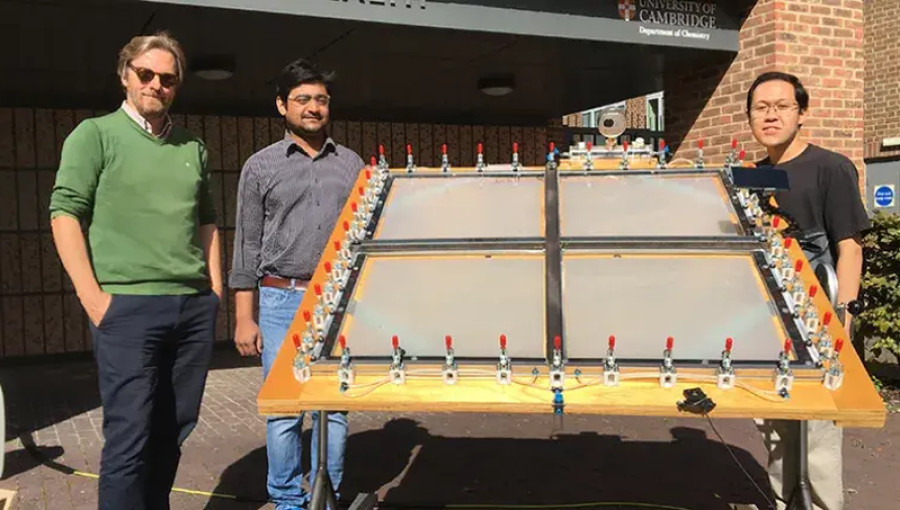
Researchers at the University of Cambridge have successfully scaled up a solar-powered technology capable of transforming plastic waste into clean hydrogen fuel and industrial chemicals. While previous iterations of this reactor were limited to laboratory settings, the team has now demonstrated a functional, one-square-metre device operating under natural sunlight. By moving from a small-scale catalyst to a larger, outdoor-ready system, the scientists have established a viable pathway for commercial application. This breakthrough marks the first time such a process has been effectively deployed in real-world conditions, offering a sustainable method for repurposing plastic waste into valuable energy resources.
The project builds upon earlier work where the team proved that plastic bottles and other waste materials could be converted into hydrogen using solar energy. Initially, these experiments were restricted to controlled environments using a 25-centimetre square reactor. To prove the technology could be useful outside of a lab, the researchers developed a significantly larger device measuring one square metre. This expanded system was tested outdoors at the university’s Chemistry Department, confirming that the conversion process remains efficient and stable when exposed to natural, fluctuating sunlight rather than artificial light sources.
This advancement is a critical step toward addressing the global plastic crisis while simultaneously producing clean fuel. By utilizing scalable techniques, the researchers have shown that the technology is not merely a theoretical concept but a practical solution for waste management. The ability to operate at this scale in an outdoor environment suggests that the process could eventually be integrated into industrial workflows, turning discarded plastics into a source of renewable energy. The team’s success in transitioning from a small catalyst to a large-scale reactor provides a clear roadmap for the future commercialization of this solar-driven recycling technology.