
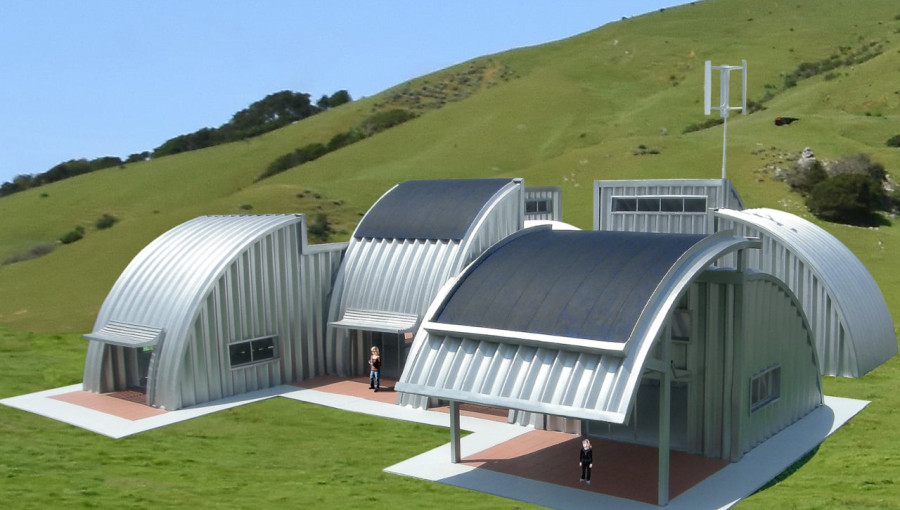
Designer Michael Jantzen has introduced the Homestead House, a conceptual off-grid residence that repurposes prefabricated steel arch systems typically utilized in agricultural settings. By leveraging existing, fire-resistant, and structurally sound building components, the design avoids the need for new manufacturing processes or specialized labor. The modular nature of the steel arches allows for flexible configurations, enabling homeowners to expand or reduce their living space as needs evolve. This approach emphasizes sustainability by utilizing readily available materials, offering a practical and highly adaptable alternative to conventional construction methods while maintaining a focus on long-term structural durability.
The construction process relies on thin, recyclable steel sheets that are bolted together without the need for secondary support structures. This design ensures that the building is not only strong but also fully reversible; the entire structure can be disassembled and relocated, significantly extending the lifecycle of the materials. To address varying climate requirements, the house features a dual-layer shell system. A lighter-gauge interior structure is erected within the outer steel frame, allowing for the installation of recycled cellulose insulation at depths tailored to specific environmental conditions, from mild coastal areas to harsh inland climates.
Energy independence is a core component of the Homestead House, which is designed to function entirely off the utility grid. The structure integrates photovoltaic cells and a vertical-axis wind turbine to generate electricity, while passive solar design principles manage heating and cooling needs. Domestic water is heated via solar energy, and the curved roof arches facilitate the collection of rainwater for storage. The framework also considers advanced energy solutions, such as solar- and wind-powered hydrogen production, ensuring the home remains self-sufficient. By utilizing existing agricultural infrastructure, the design demonstrates that sustainable housing can be achieved through creative application rather than resource-intensive innovation.